


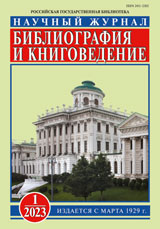
“Bibliography and Bibliology” journal has been published by the Russian Book Chamber since 1929. It is the oldest of all Russian professional journals on bibliography, bibliology and book industry. The main topics of the journal include theory, methodology and practice of information and bibliographic activities, bibliology, information support of various branches of science and industry, librarianship, printing statistics, publication design culture. The journal informs its readers about the planned and already developed standards, norms and rules of bibliographic description and publication on terminology, printing statistics and design of publications, international standard numbering of books, serial publications, publications of musical works.
“Bibliography and Bibliology” journal is included in the “List of Peer-Reviewed Scientific Publications That Should Publish the Main Scientific Results of Dissertations for the Degree of Candidate of Sciences, for the Degree of Doctor of Sciences” of the Higher Attestation Commission under the Ministry of Science and Higher Education of the Russian Federation, and is also included in the Russian Science Citation Index.
Current issue
 Open Access
 Subscription Access
PROBLEMS. FACTS. SOLUTIONS
The article reveals the history of the preparation and publication of a book series based on materials from the Scientific and Bibliographic Archive of the Russian Book Chamber. It outlines the subject matter of each of the 8 volumes in the series, as well as the content and structure of the archival fund itself. Published since 2011, this series introduces previously unknown documents and materials into scholarly circulation, drawing from the personal collections of numerous outstanding Russian bibliologists, bibliographers, and library scientists, including N.M. Lisovsky, N.V. Rusinov, N.V. Chekhov, E.I. Shamurin, D.D. Yazykov, and N.F. Yanitsky. As director from 1921 to 1931, N.F. Yanitsky contributed significantly to establishing the USSR’s largest scientific and bibliographic center and launching the scholarly journal Bibliography (1929), from which the current journal Bibliography and Bibliology traces its history.
This article provides an overview of the personal archival collections of historians preserved in the Yakub Kolas Central Scientific Library of the National Academy of Sciences of Belarus. It examines how these collections were accumulated, highlighting their specific acquisition patterns and assessing the prospects for their further study as sources for researching the history of Belarusian scholarship. The article focuses on the collections of historians S. Sakharov, I. Filippovich, N. Ulashchik, I. Kravchenko, K. Shabunya, M. Bich, and P. Selivanov, as well as the archaeologist V. Tarasenko and the ethnographer M. Grinblat. These personal archival materials are characterized in terms of their source-study potential, with a particular emphasis on revealing the connections between Belarusian scholars and all-Union scientific, cultural, and informational centers. These centers include the V.I. Lenin State Library of the USSR, the Institute of Scientific Information on Social Sciences of the USSR Academy of Sciences, the Institute for the History of Material Culture of the USSR Academy of Sciences, and the Institute of History of the USSR.
DISCUSSIONS AND SPECULATIONS
This article analyzes the informational potential of archival manuscript collections belonging to Belarusian scholars and preserved in the Central Scientific Library of the National Academy of Sciences of Belarus as sources for studying commemorative practices in Belarusian society from the 1940s to the 1970s. Examining materials from the personal archives of several leading academics, the study explores the involvement of the intellectual elite in both pan-Soviet celebrations — such as May Day and the 150th anniversary of Karl Marx — and local Belarusian commemorations, including the anniversary of the formation of the BSSR, the 450th anniversary of Belarusian book printing, and the honoring of the memory of the national poet Yakub Kolas. The author concludes that these personal collections not only document reactions to the rituals established in Soviet society but also demonstrate the initiatives of the academic community in shaping the historical memory of Belarus.
This article analyzes the information potential of correspondence belonging to Belarusian Soviet scholars as a source on the history of science during the Great Patriotic War and the post-war reconstruction period. The value of these epistolary documents is emphasized as unique evidence revealing the internal processes within the academic community, as well as the influence of personal factors of historical actors on scientific activity. Drawing on the epistolary heritage preserved in the Central Scientific Library of the National Academy of Sciences of Belarus, the study demonstrates how scholars’ letters can be utilized to explore the country’s scientific development, academic biographies, and social history.
PAGES OF HISTORY
The article reintroduces into scientific circulation a unique 16th-century Kormchaya Kniga (Book of the Helmsman) of the Lukashevich redaction, acquired by Count N.P. Rumyantsev in Gomel (now the Republic of Belarus), apparently in early January 1823. The book was subsequently listed under No. 234 in the Description of Russian and Slavic Manuscripts of the Rumyantsev Museum, prepared by A.Kh. Vostokov (1842). However, since 1845, this Book of the Helmsman has been recorded as missing. In the early 20th century, this fact was established by S.I. Smirnov, a historian of church law and professor at the Moscow Theological Academy, who published it among the commentaries to his study, Materials for the History of Old Russian Penitential Discipline (1912). Nevertheless, in 2025, the author of this article succeeded in discovering the missing monument in a Moscow bibliophile collection and fully examining it.
This article examines the informational potential of archival materials belonging to the writer Maksim Luzhanin (1909—2001), preserved in the Yakub Kolas Central Scientific Library of the National Academy of Sciences of Belarus, as primary sources for studying the history of Belarusian-Russian literary relations. The focus is on creative texts and memoirs from the second half of the 1980s and 1990s, illustrating the author’s individual process of understanding and representing the literary life of the first Soviet decade. M. Luzhanin’s documentary heritage highlights the keen interest of young Belarusian writers in the works of Sergei Yesenin, Nikolai Gumilyov, and others. Archival materials relating to the creative legacy of A. Akhmatova, as well as A. Tvardovsky’s connections with the Belarusian cultural landscape, are introduced into scientific circulation.
SOURCE STUDIES OF THE HISTORY OF BIBLIOGRAPHY
The article completes the introduction into scientific circulation of the correspondence between U.G. Ivask (1878—1922) and A.V. Selivanov (1851—1915), two prominent figures in Russian book culture. It presents their epistolary dialogue from 1912 to 1914. The published corpus includes 25 letters held in the personal archival funds of the addressees in the State Archive of the Ryazan Region and the Department of Manuscripts of the Russian State Library, and in the Department of Rare Books of the Zonal Scientific Library of Voronezh State University. The epistolary communication during this period covers a wide range of topics: the mutual exchange of printed works, discussions of issues related to collecting, bibliography, and genealogy, assistance in acquiring rare publications and archival materials, among others. Of particular interest is the discussion about the essence of collectibles that arose around A.V. Selivanov’s pamphlet The Soul of Things (Skopin, 1912). U.G. Ivask did not share his correspondent’s view on the mystical nature of the mutual attraction of collectible items, believing that purposeful collecting activities were more effective. U.G. Ivask’s explanation of his approach to creating the book Grigory Nikolaevich Gennadi: A Review of His Life and Works (Moscow, 1913) is significant for the history of bibliography. The correspondence also reveals the circumstances surrounding U.G. Ivask’s review of A.V. Selivanov’s genealogical work Materials for the History of the Ryazan Selivanov Family in the journal Russian Archive.
BIBLIOPHILE’S SHELF
This article presents the outcomes of the research and bibliographic work conducted by the staff of the Yakub Kolas Central Scientific Library of the National Academy of Sciences of Belarus within the framework of the fundamental project “The Library of the Nesvizh Ordination of the Radziwills in the Collections of the CSL of the NAS of Belarus: Study of the Composition and Scientific Description of Documents”. From 2005 to 2025, printed publications (including convolutes) from the library of the Nesvizh Ordination (entail) of the Radziwill princes — prominent magnates of the Grand Duchy of Lithuania — were identified, cataloged, and scientifically described. The twenty volumes (including main and supplementary issues) published in Minsk between 2010 and 2025, with the final volume presented in January 2026, record 2,889 editions in various languages spanning from the 15th century to the 1930s. The author emphasizes that this unique phenomenon in the history of Belarusian book culture highly deserves further scholarly investigation.
SURVEYS AND CRITICAL REVIEWS
The Sretensky Monastery Publishing House has completed its project to release a facsimile edition of the Gennady Bible (Genadiyevskaya Bibliya). By 2025, all nine volumes of the landmark publication were issued, continuing an initiative originally launched in the 1990s as the “Russian Bible” project by Archimandrite Innocent (Prosvirnin). The work was carried out jointly with the State Historical Museum, where the original manuscript is preserved. The article shows that the text of the Gennady Bible is of great interest not only for the history of its creation — including its manuscript tradition and textual preparation — but also for the development of biblical publishing methodologies. This experience remains highly relevant for modern book publishing, specifically regarding the parallel publication of the Church Slavonic original and the Russian translation. Furthermore, the article addresses the challenges of publishing biblical texts, drawing on past initiatives by the Russian State Library and the State Historical Museum. Finally, it examines the activities of Moscow and Novgorod scribes, as well as historical continuity in biblical textology from the 15th century through the Modern Period to the present day.
CHRONICLE
The article describes the All-Russian Scientific Conference “The Saltykov Readings”, dedicated to the 200th anniversary of the birth of Mikhail Yevgrafovich Saltykov-Shchedrin (1826—1889), a classic writer of Russian literature. The event was held at the A.I. Herzen Kirov Regional Scientific Library (founded as the Vyatka Public Library), which carefully preserves materials about the writer who was exiled to Vyatka from 1848 to 1855. The conference participants discussed a wide range of issues related to the biography, works, and challenges of studying the literary legacy of M.E. SaltykovShchedrin in the modern period. They also presented information about a new volume of conference proceedings, published ahead of the event (the previous readings took place in 2016).
The authors of the article summarize the results of the round table Artificial Intelligence for Libraries or Libraries for Artificial Intelligence, held on March 23, 2026, as part of the International Scientific and Practical Conference “LIBWAY-2026: Science, Technology and Information in Libraries”. They note that the implementation of AI in libraries faces a number of challenges. A potential solution is seen in cooperation with technology partners (Sberbank, Yandex, etc.), as well as in the creation of professional development courses for staff and the integration of AI services into electronic library systems.
On April 15, 2026, the All-Russian Institute of Scientific and Technical Information of the Russian Academy of Sciences hosted the Scientific and Methodological Seminar “UDC 2026”, dedicated to current issues in the development and application of the Universal Decimal Classification. The focus was on the transition of the UDC from a traditional bibliographic tool to a dynamic digital platform. Presentation topics covered the automatic interpretation of complex UDC indices and their representation in machinereadable formats, the creation of a national digital infrastructure for the tables (electronic catalogue, programmatic access via API, semantic search), as well as practical aspects of the indexing methodology for multi-aspect documents. Special emphasis was placed on the pilot implementation of the UDC electronic catalogue in the Library for Natural Sciences of the Russian Academy of Sciences — the first library to gain access to the system. The seminar captured the dual nature of the UDC as both a stable hierarchical structure and a flexible analytical-synthetic apparatus, opening up opportunities for creating personalized classifiers based on modern data processing technologies.
This review analyzes the outcomes of the track “User Information Services in the Digital Age: Resources, Methods, Tools,” held on May 20, 2026, as part of the All-Russian Library Congress (the 30th Annual Conference of the Russian Library Association). The Main Library and Information Center of the Yekaterinburg Municipal Library Association served as the professional platform for the discussions, highlighting the event’s distinct practical orientation. The track program was structured into several thematic blocks: information resources and services, delivery methods, and the popularization of library services alongside user engagement. The diversity of presentation topics, the high number of participants, and the creative atmosphere reaffirmed the vital need for further professional communication and knowledge sharing. The recommendations formulated by the attendees synthesize theoretical frameworks and empirical data, thereby determining their significant potential impact on the evolution of library services across Russia.
Announcements
2025-12-30
Почетная грамота Президента РФ
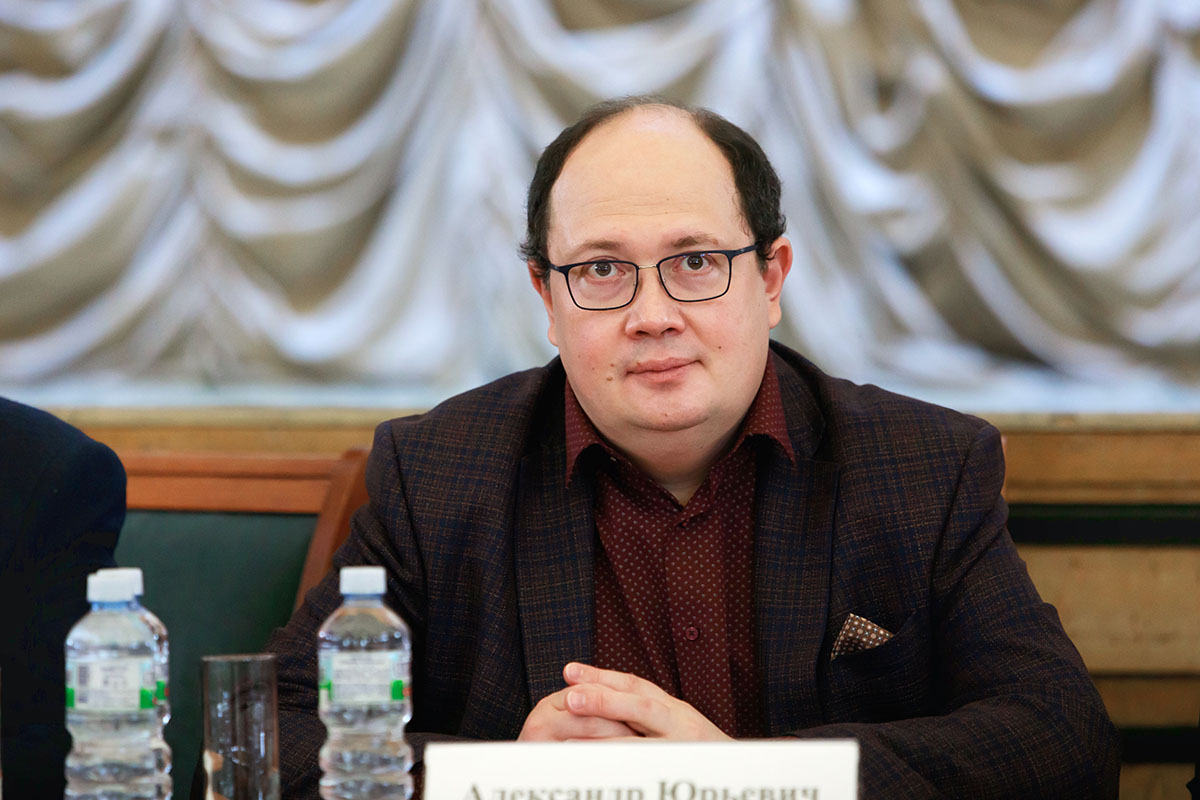 За активное участие в подготовке и проведении общественно значимых мероприятий Почетной грамотой Президента Российской Федерации награжден заместитель генерального директора Российской государственной библиотеки по научно-издательской работе, доктор исторических наук, доцент, заслуженный работник культуры Российской Федерации Александр Юрьевич Самарин, член редколлегии журнала «Библиография и книговедение» и редакционного совета журнала «Обсерватория культуры», главный редактор журнала «Библиотековедение» (Распоряжение Президента РФ № 514-рп, от 29.12.2025).
Поздравляем Александра Юрьевича и желаем ему новых творческих достижений!
| More Announcements... |


